
Hollow Glass Microspheres Applications
From Building Energy Conservation to Marine, Automotive, Aerospace and Defense Materials
Ocean Elite Hollow Glass Microspheres are used across high-performance material systems where low density, insulation, dimensional stability, improved flowability, structural weight reduction, buoyancy performance, and reduced thermal conductivity are required.
Thermal Insulation
Dimensional Stability
Improved Flowability
Structural Weight Reduction
Buoyancy Performance
Building Energy Saving
For insulation boards, lightweight concrete, roof insulation and fireproof coatings.
Industrial Coatings
For anti-corrosion, thermal insulation and durable composite protection.
Solid Buoyancy
For syntactic foam, deep-sea robots, marine buoys and naval equipment.
Automotive Materials
For PP, PA6, SMC, BMC, NVH parts and EV battery insulation coatings.
Aerospace Systems
For sandwich structures, composite panels, radomes and cabin insulation.
Technical Selection
Application-based support for material systems, processing and performance needs.
Overview of Application Fields of the Product
As global manufacturing evolves toward lightweight, energy-saving, and multi-functional development, Hollow Glass Microspheres are gradually upgrading from traditional fillers to key functional components in engineering material systems.
Compared with conventional mineral fillers, hollow glass microspheres can reduce material density while also providing thermal insulation performance, reduced shrinkage, improved dimensional stability, enhanced flowability, structural weight reduction, boosted buoyancy performance, and lower thermal conductivity.
- Thermal insulation performance
- Reduced shrinkage
- Improved dimensional stability
- Enhanced flowability
- Structural weight reduction
- Boosted buoyancy performance
- Lower thermal conductivity
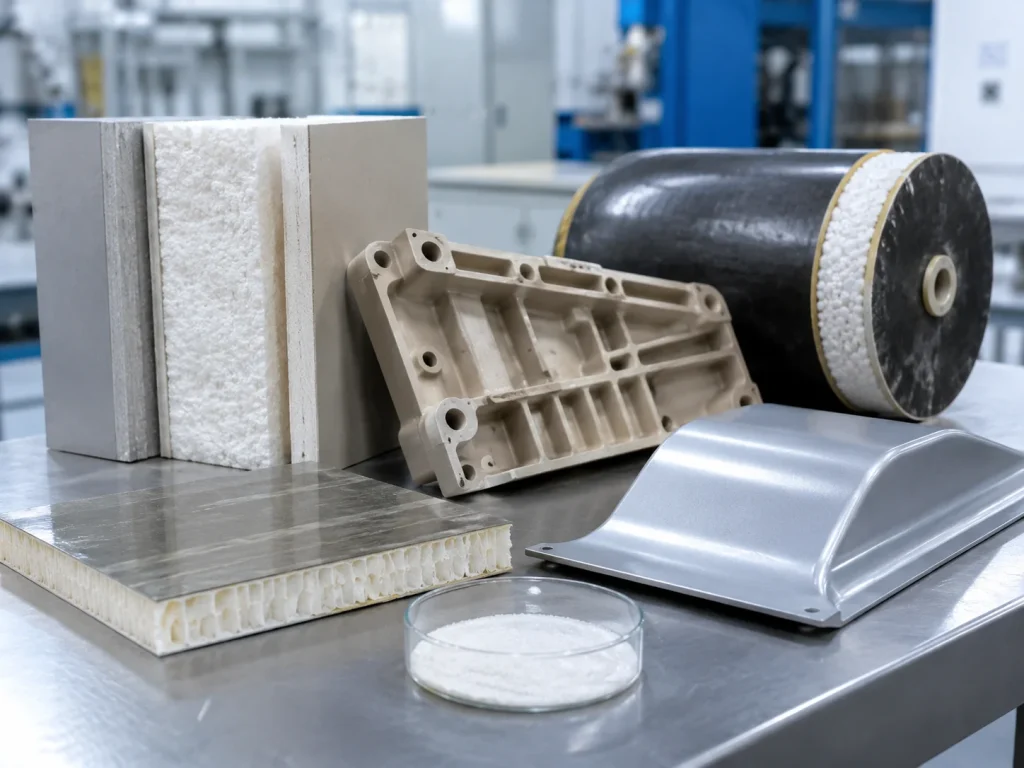
Hollow Glass Microspheres Application Structure
This page follows four major application fields from the document. Each field is expanded into its original sub-application directions instead of adding unrelated industries or removing key application content.
| Main Application Field | Sub-Application Directions from Document | Core Engineering Value |
|---|---|---|
| Building & Energy-Saving Materials | Exterior wall insulation systems, Class A fireproof boards, lightweight concrete, roof insulation, fireproof coatings, heat-reflective coatings | Thermal insulation, reduced building load, dimensional stability, better workability |
| Industrial Coatings & Composite Materials | Anti-corrosion coatings, solid buoyancy materials, industrial furnaces and high-temperature insulation | Corrosion protection, lower thermal conductivity, buoyancy support, heat loss reduction |
| Automotive & Transportation Fields | Lightweight plastic parts, NVH components, new energy battery insulation coatings | Lower vehicle weight, better dimensional stability, noise reduction, thermal management |
| Aerospace & National Defense | Low-density structural materials, cabin insulation, naval equipment buoyancy systems | Performance-to-weight ratio, fuel efficiency, payload improvement, hydrostatic reliability |
Note: Application selection should consider density reduction target, thermal conductivity requirement, strength demand, processing method, long-term reliability, and operating environment.
Hollow Glass Microspheres Application Selection Guide
Different application systems require different performance priorities. Use this guide to match the material direction with the real working environment instead of selecting HGM only by density.
| Selection Direction | Main Factor | Suitable Applications | Selection Note |
|---|---|---|---|
| Thermal insulation and fire protection | Low thermal conductivity, low water absorption, fire stability | Class A fireproof boards, roof insulation, fireproof coatings | Focus on thermal performance, density reduction, and long-term stability |
| Industrial coating durability | Barrier path, lower density, coating volume, durability | Anti-corrosion coatings, tank coatings, pipeline protection | Check compatibility with coating resin and service environment |
| Automotive lightweighting | Density reduction, dimensional stability, flowability | PP, PA6, SMC, BMC, NVH parts, battery insulation coatings | Match particle strength and processing conditions |
| Buoyancy and extreme environment use | Low density, hydrostatic pressure resistance, low water absorption | Solid buoyancy materials, syntactic foam, naval equipment systems | Prioritize long-term pressure stability and water resistance |
How to Choose the Right HGM Application Direction?
Select the application path based on density target, thermal insulation demand, pressure environment, processing method, dimensional stability, and long-term reliability.
Building Energy Saving
Industrial Coatings & Composites
Automotive Lightweighting
Aerospace & Defense Materials
Key Selection Factors for Hollow Glass Microspheres Applications
Low Density
Helps reduce system weight in building, automotive, marine and aerospace materials.
Thermal Insulation
Closed air cavity structure supports reduced heat conduction and insulation performance.
Dimensional Stability
Supports lower shrinkage, reduced deformation and improved system stability.
Flowability
Spherical particles help improve workability, spraying, troweling and resin flow behavior.
Buoyancy Reliability
Supports syntactic foam and marine buoyancy systems under demanding environments.
Hollow Glass Microspheres Applications by Industry
Building & Energy-Saving Materials
Industrial Coatings & Composite Materials
Automotive & Transportation Fields
Aerospace & National Defense
Building and Energy-Saving Materials Application Details
This extended section is added because the document contains detailed building material information beyond the standard application card framework.
Thermal Insulation Boards
HGM can reduce heat conduction paths by forming numerous closed air cavity structures.
- Reduced thermal conductivity
- Lower system density
- Improved dimensional stability
- Better workability
Class A Fireproof Systems
The glass substrate itself has good high-temperature stability and is suitable for industrial buildings, public facilities, and new energy factories.
Lightweight Concrete
Uniform particle size and stable spherical structure help improve the internal microstructure of concrete.
- Reduced overall density
- Enhanced flowability
- Less sedimentation
- Lower pumping pressure
- Improved thermal insulation
| Performance Direction | Effect |
|---|---|
| Reduced thermal conductivity | Enhanced thermal insulation performance |
| Lower system density | Reduced building load |
| Improved dimensional stability | Minimized thermal expansion and contraction deformation |
| Better workability | Improved leveling for spraying and troweling |
Industrial Coatings and Composite Materials Application Details
This section keeps the document’s three industrial directions: anti-corrosion coatings, solid buoyancy materials, and industrial furnace/high-temperature insulation.
Anti-Corrosion Coatings
HGM can form a more complex barrier path inside coatings, helping prolong the penetration time of corrosive media.
- Marine anti-corrosion coatings
- Storage tank outer wall coatings
- Pipeline thermal insulation and anti-corrosion
- Industrial equipment protective layers
Solid Buoyancy Materials
Hollow glass microspheres are compounded with resin matrices to form Syntactic Foam for deep-sea buoyancy materials.
- Deep-sea robots
- Underwater detection equipment
- Marine buoys
- Naval equipment buoyancy systems
Industrial Furnaces & High-Temperature Insulation
The internal closed gas structure can reduce heat conduction in industrial furnaces, thermal equipment, and high-temperature pipeline systems.
- Industrial furnace linings
- High-temperature thermal insulation mortars
- Pipeline insulation layers
- Thermal equipment insulation coatings
| Function | Effect |
|---|---|
| Reduced thermal conductivity | Minimized heat transfer |
| Lower density | Lighter coating weight |
| Improved hiding power | Increased coating volume |
| Enhanced durability | Extended service life |
Automotive and Transportation Application Details
The automotive industry is undergoing electrification, lightweighting, NVH optimization, and thermal management upgrading. The value of hollow glass microspheres in automotive material systems continues to expand.
Lightweight Plastic Parts
In PP, PA6, SMC, BMC and other systems, HGM helps reduce material density, reduce vehicle weight, reduce warping and deformation, and improve dimensional stability.
- Instrument panels
- Door panels
- Structural parts
- Battery housings
- Interior parts
Noise Reduction and NVH Components
The closed cavity structure inside hollow glass microspheres can absorb vibration and sound waves to a certain extent.
- Automotive damping plates
- Sound-absorbing composite materials
- Sealants
- Floor sound insulation layers
New Energy Battery Insulation Coatings
HGM can be used for battery pack insulation layers, flame-retardant thermal insulation coatings, and thermal runaway mitigation systems.
| Function Direction | Engineering Value |
|---|---|
| Low thermal conductivity | Reduced heat diffusion |
| Low density | Less extra weight |
| Temperature-resistant stability | Improved safety |
| Electrical insulation | Enhanced system reliability |
Aerospace and National Defense Application Details
The core logic of aerospace materials is not low cost, but lighter weight, higher strength, better stability, and stronger reliability. Hollow glass microspheres have long-term value in aerospace and national defense applications.
Low-Density Structural Materials
In composite material systems, HGM helps reduce overall density while maintaining certain structural strength.
- Sandwich structures
- Composite panels
- Radomes
- Cabin structural materials
Cabin Thermal Insulation Materials
Aircraft, high-speed equipment, and special cabin environments require a balance of thermal insulation, flame retardancy, and lightweighting.
- Cabin insulation layers
- High-temperature equipment cladding
- Aerospace composite insulation structures
Naval Equipment Buoyancy Systems
Marine national defense buoyancy systems require stable buoyancy, resistance to long-term seawater immersion, high hydrostatic pressure resistance, low water absorption, long-term dimensional stability, and high-pressure crush resistance.
Ocean Elite Application Selection Do’s
Recommended Sourcing Practices
✅ Define the target application environment clearly
✅ Match density, insulation, strength and buoyancy requirements
✅ Check process compatibility before scale-up
✅ Validate application-specific performance through testing
✅ Select grades according to long-term reliability needs
Common Application Selection Mistakes
❌ Choosing only by low density without checking strength
❌ Ignoring water absorption and pressure resistance in marine systems
❌ Using coating fillers without checking barrier and durability needs
❌ Ignoring thermal management requirements in EV applications
❌ Overlooking dimensional stability in construction and aerospace parts
Customization & Technical Support
Ocean Elite can support application-oriented HGM selection based on density target, thermal conductivity needs, pressure environment, processing method, and final material performance requirements.
- Application requirement review
- Density and thermal conductivity matching
- Particle size and strength grade selection
- Processing compatibility guidance
- Application-specific technical support
Quality-Controlled Hollow Glass Microspheres with Testing Documentation
Reliable application performance depends on stable material quality, particle size distribution, density control, and application-oriented testing documentation.
- Incoming material inspection
- Density and particle size testing
- Thermal conductivity and application matching
- Moisture and appearance control
- Application-specific technical support

Frequently Asked Questions
1.What are hollow glass microspheres mainly used for?
Hollow glass microspheres are used in building energy conservation, marine engineering, industrial coatings, automotive lightweighting, aerospace, and national defense material systems where low density, thermal insulation, dimensional stability, improved flowability, buoyancy performance, and lower thermal conductivity are required.
2.How do hollow glass microspheres help building insulation materials?
Hollow glass microspheres help form numerous closed air cavity structures, reducing heat conduction paths. They can be used in exterior wall insulation systems, Class A fireproof and thermal insulation boards, lightweight concrete, roof insulation materials, fireproof coatings, and heat-reflective thermal insulation coatings.
3.Can hollow glass microspheres be used in anti-corrosion coatings?
Yes. In marine, chemical, storage tank, and pipeline environments, hollow glass microspheres can form a more complex barrier path inside coatings, helping extend the penetration time of corrosive media while supporting lower thermal conductivity, lower coating weight, improved hiding power, and enhanced durability.
4.Why are hollow glass microspheres used in solid buoyancy materials?
In deep-sea buoyancy materials, hollow glass microspheres are usually compounded with resin matrices to form syntactic foam. This material system provides low density, high hydrostatic pressure resistance, long-term low water absorption, and stability in deep-sea environments.
5.How do hollow glass microspheres support automotive lightweighting?
In PP, PA6, SMC, BMC, and other systems, hollow glass microspheres help reduce material density, reduce vehicle weight, reduce warping and deformation, and improve dimensional stability. They can also be used in automotive damping plates, sound-absorbing composites, sealants, floor sound insulation layers, and new energy battery insulation coatings.
6.Why are hollow glass microspheres valuable in aerospace and national defense applications?
Hollow glass microspheres provide a high performance-to-weight ratio. They can be used in sandwich structures, composite panels, radomes, cabin structural materials, cabin insulation layers, high-temperature equipment cladding, aerospace composite insulation structures, and naval equipment buoyancy systems.