Advanced Engineering Material Product Categories
Select the right material by density, strength, and application needs.
Ocean Elite helps engineers and technical buyers compare Hollow Glass Microspheres, Solid Buoyancy Materials, and A1 Fireproof Thermal Insulation Materials for lightweighting, buoyancy, and fireproof insulation projects.
Low Density
High Strength
Thermal Insulation
Deep-Sea Buoyancy
A1 Fire Resistance
20+
Years of Materials Expertise
100+
Countries & Regions Served
5000+
Customers in Performance Industries
ISO 9001
Certified Quality Management
Consistent Quality
Batch-to-batch Stability
High-Performance Engineering Materials from Ocean Elite
Ocean Elite provides advanced engineering materials for lightweight composites, marine buoyancy systems, and fireproof thermal insulation projects. Each product category is designed around real engineering needs such as density reduction, pressure resistance, thermal control, fire safety, and long-term stability.
Our main product categories include Hollow Glass Microspheres, Solid Buoyancy Materials, and A1 Fireproof Thermal Insulation Materials. These materials are used in coatings, adhesives, plastics, oilfield systems, deep-sea equipment, building insulation, industrial pipelines, and high-temperature protection systems.
Instead of choosing materials only by product name, buyers should compare density, strength, thermal conductivity, water absorption, fire rating, processing method, and final application environment.
- Low density for lightweight formulation
- High strength for processing and pressure resistance
- Thermal insulation for energy-saving systems
- Deep-sea buoyancy for marine engineering
- A1 fire resistance for building and industrial protection
- Custom material support for project-specific requirements
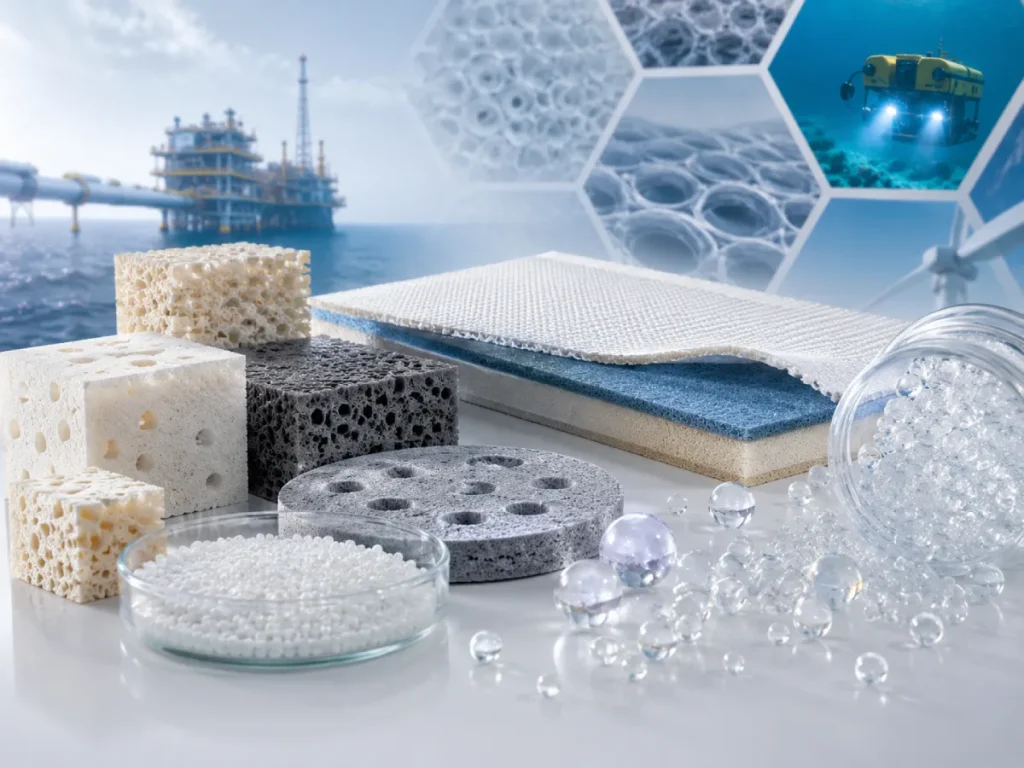
Engineering Material Categories Performance Summary
| Characteristic Dimension | Core Parameters | Core Performance |
|---|---|---|
| Hollow Glass Microspheres | True density: 0.15–0.60 g/cm³; compressive strength: 500–18,000 psi; D50: 30–60 μm; recommended addition: 3–20 wt% | Lightweight inorganic fillers for composites, coatings, adhesives, plastics, oilfield cementing, aerospace, and electronics applications. |
| Solid Buoyancy Materials | Density: 0.36–0.70 g/cm³; operating depth: up to 11,500 m; hydrostatic compressive strength: ≥25–170 MPa; water absorption: typically <0.5% | High-buoyancy and pressure-resistant materials for ROVs, submersibles, subsea mining vehicles, risers, pipeline supports, and marine engineering systems. |
| A1 Fireproof Thermal Insulation Materials | Fire rating: A1; thermal conductivity: 0.04–0.068 W/m·K; service temperature: -200–800°C; bulk density: 0.09–0.23 g/cm³ | Non-combustible inorganic insulation materials for buildings, roofs, walls, industrial pipelines, cold-chain systems, and high-temperature equipment protection. |
| Material Selection Logic | Compare density, strength, thermal conductivity, water absorption, fire rating, and application environment. | Helps engineers choose the right material category before moving into detailed grade selection. |
| Application Fit | Lightweighting, buoyancy support, fireproof insulation, thermal protection, pressure resistance, and energy-saving systems. | Reduces material selection risk and improves project-level performance matching. |
Engineering Material Categories & Technical Parameters
| Product Category | Density Range | Key Strength / Rating | Thermal Performance | Main Application |
|---|---|---|---|---|
| Hollow Glass Microspheres | 0.15–0.60 g/cm³ | 500–18,000 psi compressive strength | 0.04–0.10 W/m·K | Coatings, adhesives, plastics, rubber, oilfield cementing, composites |
| Solid Buoyancy Materials | 0.36–0.70 g/cm³ | ≥25–170 MPa hydrostatic compressive strength | Application-dependent | ROVs, submersibles, buoyancy blocks, risers, pipeline supports |
| A1 Fireproof Thermal Insulation Materials | 0.09–0.23 g/cm³ | A1 non-combustible; compressive strength up to 2.7 MPa | 0.04–0.068 W/m·K | Building insulation, industrial pipelines, roofs, cold-chain systems |
| Custom Material Support | Project-dependent | Based on application requirements | Based on insulation or service environment | Density, strength, size, thickness, surface treatment, packaging |
Note: The above data are typical reference values. Custom specifications can be tailored according to application requirements, processing method, operating depth, fire rating, temperature range, and project documentation needs.
How to Choose the Right Engineering Material Category?
Select the optimal grade based on your target density, mechanical requirements, processing conditions, resin system, and final application environment. Choosing the wrong grade may cause crushing during processing, poor dispersion, unstable viscosity, or insufficient weight reduction.
Key Selection Factors for Engineering Materials

Density
Density affects final product weight, buoyancy behavior, insulation layer load, and formulation efficiency. Lower density helps reduce weight, but it must be balanced with strength and long-term stability.

Compressive Strength
Strength determines whether the material can survive mixing, molding, pressure exposure, construction, or underwater service. Different applications require different strength levels.

Thermal Conductivity
Thermal conductivity affects insulation and energy-saving performance. It is especially important for coatings, building insulation, industrial pipelines, cold-chain systems, and high-temperature equipment.

Water Absorption
Low water absorption is critical for marine engineering and long-term outdoor or humid environments. Poor water resistance may reduce buoyancy, insulation performance, and structural stability.

Fire Rating
Fire rating matters for building and industrial insulation projects. A1-grade non-combustible materials are suitable when fire safety and smoke-free performance are required.
Application Matching
Lightweight Composites
Best-fit materials: Hollow Glass Microspheres with suitable density, particle size, and compressive strength.
Coatings & Adhesives
Best-fit materials: Low-density or medium-strength Hollow Glass Microspheres.
Oilfield & Drilling Systems
Best-fit materials: High-strength Hollow Glass Microspheres for pumping and pressure conditions.
Marine & Deep-Sea Equipment
Best-fit materials: Solid Buoyancy Materials with matched density and hydrostatic strength.
Building Insulation
Best-fit materials: A1-grade inorganic thermal insulation materials.
Industrial Thermal Protection
Best-fit materials: A1 insulation materials selected by thermal conductivity, thickness, and service temperature.
Engineering Material Sourcing Do's and Don'ts
Recommended Sourcing Practices
✅ Match the material category to the real application environment.
✅ Compare density, strength, and stability together before selection.
✅ Run pilot-scale testing before bulk production or installation.
✅ Request test data, storage guidance, and technical documentation.
Common Sourcing Mistakes
❌ Choosing the lowest-density option without checking strength.
❌ Using one material category across different environments without testing.
❌ Ignoring water depth, fire rating, temperature range, or resin compatibility.
❌ Skipping packaging, moisture control, and long-term performance review.
Customization & Technical Support
* Particle size and density selection
* Compressive strength optimization
* Hydrostatic pressure resistance matching
* Thermal conductivity and thickness support
* Surface treatment for resin compatibility
* Packaging format customization
* Application-based sample support
* Technical documentation and test data support
Quality-Controlled Engineering Materials with Testing Documentation
Ocean Elite applies strict quality control procedures to support stable material performance across lightweight, buoyancy, and insulation applications. Key testing may include density, particle size, compressive strength, hydrostatic pressure resistance, water absorption, thermal conductivity, fire rating, appearance, packaging, and batch consistency.
- ISO 9001 Certified Quality Management System
- Incoming Raw Material Inspection
- Particle Size, Density, Strength and Moisture Testing
- Hydrostatic Pressure and Water Absorption Testing
- Thermal Conductivity and Fire Rating Verification
- Batch Traceability and Stable Supply Assurance
- Application-specific technical data support
- Packaging inspection before delivery
For engineering buyers, quality control is not just a certificate on the page. It is the difference between stable project approval and unexpected performance failure. Ocean Elite helps customers move from sample testing to mass production with lower selection risk.
Frequently Asked Questions
What product categories does Ocean Elite provide?
Ocean Elite provides Hollow Glass Microspheres, Solid Buoyancy Materials, and A1 Fireproof Thermal Insulation Materials for lightweighting, buoyancy, fireproof insulation, thermal protection, and engineering material applications.
How do I choose the right material category?
Choose Hollow Glass Microspheres for lightweight formulation, Solid Buoyancy Materials for underwater buoyancy and pressure resistance, and A1 Fireproof Thermal Insulation Materials for non-combustible insulation and temperature protection.
Is Ocean Elite a China engineering material supplier and manufacturer?
Yes. Ocean Elite is a China engineering material supplier, manufacturer, and factory supporting global buyers with material selection, technical comparison, custom specifications, and project-based application guidance.
Which material is best for lightweight composite applications?
Hollow Glass Microspheres are usually the first choice for lightweight composite applications because they help reduce density while improving flowability, dimensional stability, and processing performance.
Which material is suitable for deep-sea buoyancy systems?
Solid Buoyancy Materials are suitable for deep-sea buoyancy systems because they provide low density, high buoyancy, hydrostatic pressure resistance, and long-term seawater stability.
Which material is suitable for fireproof insulation projects?
A1 Fireproof Thermal Insulation Materials are suitable for projects requiring A1 non-combustibility, low thermal conductivity, high/low temperature resistance, and long-term insulation performance.
Can Ocean Elite support custom material specifications?
Yes. Ocean Elite can support custom density, particle size, compressive strength, pressure resistance, thermal conductivity, thickness, surface treatment, packaging, and documentation requirements based on the target application.
What information should I provide before requesting a recommendation?
You should provide the application, operating environment, density target, strength requirement, temperature range, pressure condition, processing method, expected quantity, and documentation needs. This helps Ocean Elite recommend the right product category faster.