
Hollow Glass Microspheres for Plastics
Ocean Elite Hollow Glass Microspheres are lightweight inorganic fillers designed to help plastic formulations reduce density, improve flowability, support dimensional stability and optimize thermal management in modified PP, PA/ABS engineering plastics, automotive plastics, appliance plastics and thermoset systems.
Low Density
Improved Flowability
Dimensional Stability
Surface Finish Support
Thermal Management
Lightweight Plastic Design
Supports lower material density and lighter finished plastic components.
Plastic Processing Support
Suitable for injection molding, extrusion, compounding and thermoset systems.
Engineering Parameter Matching
Density, compressive strength, particle size and compatibility can be matched by application.
Dimensional Stability Focus
Helps reduce shrinkage, warpage and dimensional deviation in selected plastic systems.
Batch Testing Support
Pilot-scale testing is recommended before bulk compounding or injection molding production.
High-Performance Hollow Glass Microspheres for Modern Plastic Systems
Modern plastic materials are moving from general-purpose plastic applications toward lightweight design, high functionality, low shrinkage, dimensional stability, thermal management and integrated structural performance. In automotive plastics, home appliance plastics, industrial structural parts, engineering plastics, packaging materials, building materials and electronic components, engineers increasingly focus on density, warpage control, surface quality, flowability, processing efficiency and cost optimization.
Traditional mineral fillers can reduce part of the raw material cost, but they often increase density, make finished parts heavier, reduce flowability, increase injection pressure and raise the risk of warpage or visible surface defects. Hollow Glass Microspheres help address these issues through ultra-low density, hollow internal structure, spherical morphology, good fluidity, compressive strength and low thermal conductivity.
For plastic compounders and injection molding producers, Ocean Elite Hollow Glass Microspheres can be selected according to resin type, target density, processing shear, compressive strength requirement, particle size distribution and final part performance.
- Lower density for lightweight plastic compounds
- Improved melt flow behavior and mold filling efficiency
- Reduced shrinkage and better dimensional stability
- Improved surface uniformity in selected plastic systems
- Thermal insulation and thermal management support
- Suitable for PP, PA, ABS, thermoset plastics and composite systems
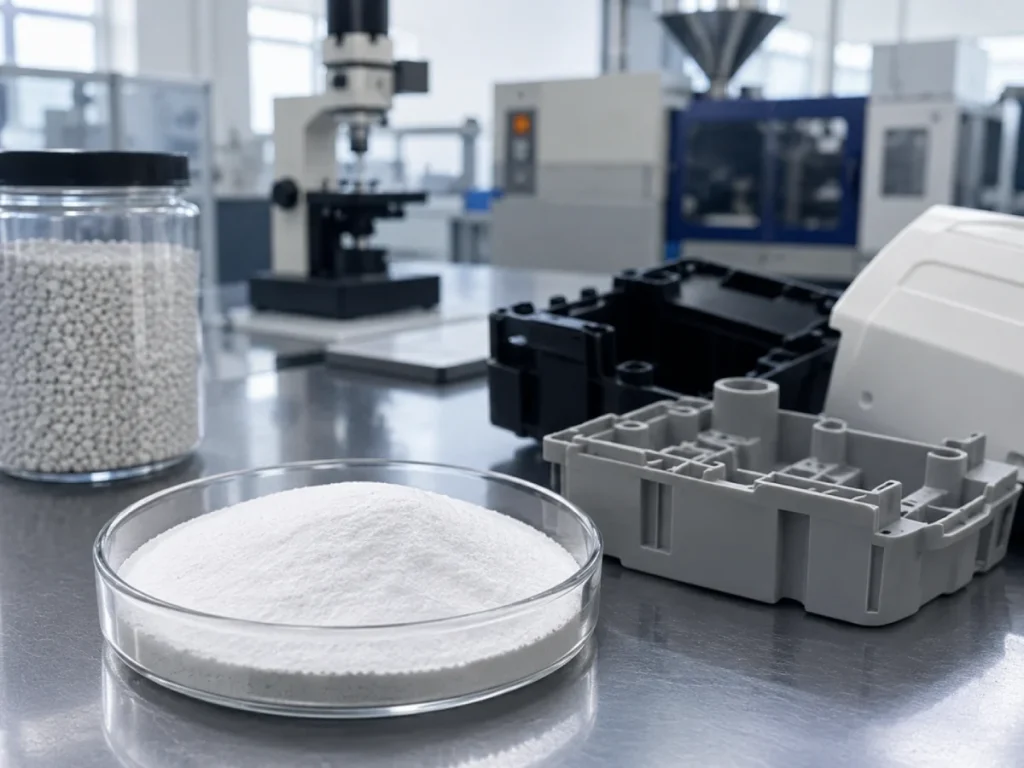
Density Comparison of Hollow Glass Microspheres and Common Plastic Fillers
One of the main reasons Hollow Glass Microspheres are used in plastic formulations is their ultra-low density. Compared with conventional mineral fillers such as calcium carbonate, talc powder and glass fiber, HGM can help reduce the overall specific gravity of plastic compounds and support lightweight material design.
| Material Type | Typical Density (g/cm³) | Plastic Formulation Impact |
|---|---|---|
| Calcium Carbonate | 2.7 | Often increases formulation weight and may reduce lightweight efficiency. |
| Talc Powder | 2.7 – 2.8 | Useful for reinforcement and cost control, but may raise material density. |
| Glass Fiber | 2.5 | Improves strength but can increase weight and affect surface finish. |
| PP / PA / ABS Resin | 0.9 – 1.3 | Base resin density varies by polymer type and formulation system. |
| Hollow Glass Microspheres | 0.15 – 0.60 | Helps reduce compound density and supports lightweight plastic design. |
Selection Note: Actual weight reduction depends on addition ratio, resin system, microsphere strength grade and processing conditions. Pilot testing is recommended before mass production.
Hollow Glass Microspheres Grades & Selection Guide for Plastics
HGM grade selection for plastics should consider density reduction target, resin matrix, processing shear, injection pressure, particle size distribution, surface compatibility and final part requirements. Choosing only by density may cause breakage, poor dispersion or unstable final performance.
| Grade Direction | Main Feature | Suitable Plastic Systems | Selection Note |
|---|---|---|---|
| Ultra-Low Density Grades | Strong lightweight effect and lower compound density | Modified PP, thermal insulation plastics, lightweight plastic parts | Suitable when weight reduction is the main target and processing shear is moderate. |
| Medium Strength Grades | Balanced density reduction and processing stability | PA/ABS engineering plastics, appliance plastics, industrial plastic parts | Suitable when both lightweight performance and stable processing are required. |
| High Strength Grades | Better resistance to high shear and injection pressure | High-shear injection molding, automotive plastic parts, engineering plastics | Recommended for demanding processing environments where microsphere breakage must be controlled. |
| Surface-Treated / Custom HGM | Improved matrix compatibility and dispersion performance | Selected resin systems, composite plastics, special engineering plastics | Suitable when resin compatibility, surface finish and dispersion stability are important. |
How to Choose the Right HGM Grade for Plastics?
Select the grade based on target density, resin type, processing method, injection pressure, shear condition, dimensional requirement and final part performance.
For stronger lightweight effect → choose lower-density grades.
For injection molding → check compressive strength first.
For PA/ABS systems → balance strength, particle size and compatibility.
For surface-sensitive parts → confirm dispersion and surface finish.
Key Selection Factors for Hollow Glass Microspheres in Plastics
True Density
True density directly affects the final lightweight effect of plastic compounds. Lower density helps reduce part weight, but grade strength and processing stability must be checked.
Compressive Strength
Plastic processing may involve injection pressure, shear force and compounding stress. High-strength HGM grades are more suitable for high-shear molding.
Particle Size Distribution
Particle size affects dispersion, flowability, surface finish and mechanical stability. Controlled D10, D50 and D90 values improve consistency.
Processing Shear
Injection molding, extrusion and compounding apply different stress levels to microspheres. Grade selection should match processing conditions.
Matrix Compatibility
Compatibility with PP, PA, ABS, epoxy, polyurethane and other resin systems affects dispersion, surface finish, bonding and final performance.
Hollow Glass Microspheres Applications by Plastic System
Modified PP Compounds
Best-fit use: Lightweight PP compounds, automotive interiors, appliance housings and injection molded plastic parts.
PA6 / PA66 Engineering Plastics
Best-fit use: Automotive functional parts, industrial structural components and electronic electrical plastic parts.
ABS & Appliance Plastics
Best-fit use: Appliance shells, electronic structural components and industrial plastic housings.
Automotive Lightweight Plastics
Best-fit use: Automotive interiors, NVH materials, structural plastic components and lightweight vehicle plastic systems.
Thermoset Plastics & Composite Systems
Best-fit use: Epoxy, polyurethane, unsaturated polyester and thermoset composite plastic systems.
Processing Compatibility for Plastic Industry
Hollow Glass Microspheres can be adapted to multiple plastic processing systems. Different processing technologies create different requirements for particle size, compressive strength, dispersion stability and surface treatment.
| Processing Technology | Typical Application | Key Selection Focus |
|---|---|---|
| Injection Molding | Engineering plastics & auto parts | Compressive strength, particle size and shear resistance |
| Extrusion | Sheets & profiles | Dispersion stability, flowability and processing consistency |
| Compounding | Modified plastic masterbatch | Mixing stability, bulk density and breakage control |
| Compression Molding | Thermoset material production | Dimensional stability and thermal insulation performance |
| Thermoset Systems | Epoxy & polyurethane products | Matrix compatibility, surface treatment and density reduction |
Hollow Glass Microspheres Sourcing Do’s and Don’ts
Recommended Sourcing Practices
✅ Define the target density, resin system and final plastic application before grade selection.
✅ Match compressive strength with processing shear, especially for injection molding and compounding.
✅ Check particle size distribution when surface finish, mold filling or dispersion stability is important.
✅ Run pilot compounding or molding tests before bulk production.
✅ Evaluate cost by volume, weight reduction and final part performance, not only by kilogram price.
Common Sourcing Mistakes
❌ Choosing the lowest-density grade without checking breakage risk during processing.
❌ Ignoring resin compatibility and surface treatment requirements.
❌ Using coating-grade selection logic directly for plastic injection molding.
❌ Skipping pilot tests for high-shear or precision plastic parts.
❌ Comparing fillers only by unit weight price instead of volumetric cost and final performance.
Customization & Technical Support
Ocean Elite can support plastic compounders, engineering plastic manufacturers and injection molding users with application-based Hollow Glass Microspheres grade selection. The goal is to help match density reduction, strength requirement, particle size, resin compatibility and processing stability before scale production.
- Density range recommendation
- Compressive strength grade matching
- Particle size distribution adjustment
- Surface treatment for resin compatibility
- Application-based sample recommendation
- Technical documentation and test data support
- Packaging format customization
Quality-Controlled Hollow Glass Microspheres with Testing Documentation
Plastic applications usually place higher requirements on compressive strength, particle size consistency, dispersion stability and processing reliability. For engineering plastic systems, batch consistency is important because density fluctuation, particle breakage or poor dispersion can affect molding stability and final part performance.
Ocean Elite focuses on stable Hollow Glass Microspheres performance for lightweight plastic materials, modified compounds and thermoset plastic systems. Before placing a bulk order, users should confirm target formulation, resin system, processing method, testing standard, and expected application environment.
Testing and Documentation Items:
- True density and tap density testing
- Compressive strength evaluation
- Particle size distribution control
- Moisture and appearance control
- Dispersion and flowability evaluation
- Batch traceability and stability assurance
- Application-specific technical data support
Recommendation: For injection molding, compounding, automotive plastics and engineering plastics, pilot testing should be completed before mass production to confirm density reduction, breakage rate, surface finish, dimensional stability and processing behavior.
Frequently Asked Questions
1. Why are Hollow Glass Microspheres suitable for plastic systems?
They feature low density, hollow structure, excellent fluidity, reliable dimensional stability and superior thermal insulation performance, ideal additives for various lightweight plastic products.
2. Can Hollow Glass Microspheres reduce plastic weight?
Yes. With typical density of 0.15–0.60 g/cc far lower than conventional mineral fillers, HGM can effectively lower the overall specific gravity of plastic compounds.
3. Are Hollow Glass Microspheres applicable to injection molding?
Yes. High-strength grades fit high-shear injection molding, engineering plastics and modified plastic systems. Select proper grades according to actual production conditions.
4. Will Hollow Glass Microspheres affect plastic flowability?
With correct grade selection and reasonable process adjustment, HGM can effectively improve melt flow behavior and mold filling efficiency of most plastic systems.
5. Are Hollow Glass Microspheres suitable for automotive plastics?
Yes. Lightweight automotive plastics are one of the core mature application fields of Hollow Glass Microspheres.