
Hollow Glass Microspheres for Composite Materials
Ocean Elite Hollow Glass Microspheres support composite systems that require lower density, higher strength-to-weight ratio, better dimensional stability, shrinkage control, improved processing efficiency, thermal management, and long-term durability.
Low Density
Strength-to-Weight Ratio
Shrinkage Control
Flowability
Thermal Management
Composite Lightweighting
Reduce formulation density and support lightweight structural design.
Strength-to-Weight
Support high-performance systems requiring lighter but stable materials.
Dimensional Stability
Help control shrinkage, warpage and thick-wall deformation risks.
Processing Flowability
Spherical particles support mold filling, dispersion and processing stability.
Thermal Management
Low thermal conductivity supports insulation and heat management needs.
Why Are More Composite Material Systems Adopting Hollow Glass Microspheres?
Modern composite materials are evolving from traditional reinforcing materials toward lightweight, high strength, multi-functional, thermal-management-oriented, long-service-life, and integrated structure-function systems.
Traditional composite systems can provide structural strength, but they often face excess overall weight, high resin consumption, obvious curing shrinkage, thick-wall deformation, limited thermal management, and increased processing load.
- Automotive composites
- Aerospace industry
- Marine engineering
- Industrial structural parts
- Engineering plastics
- SMC/BMC materials
- Deep-sea buoyancy materials
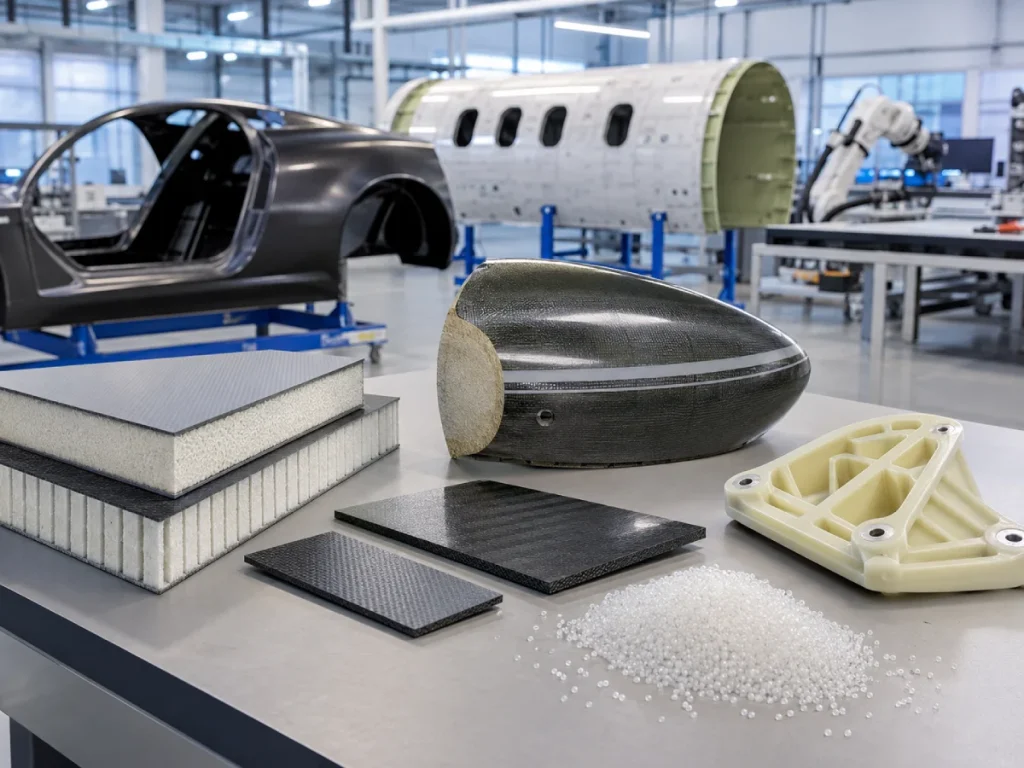
Density Reference for Composite Material Selection
Conventional reinforcing fillers usually have higher density. Hollow glass microspheres contain air or inert gas inside, helping reduce the overall specific gravity of composite formulations.
| Material Type | Typical Density (g/cm³) |
|---|---|
| Glass Fiber | 2.5 |
| Calcium Carbonate | 2.7 |
| Talc Powder | 2.7 – 2.8 |
| Resin Matrix | 0.9 – 1.3 |
| Hollow Glass Microspheres | 0.15 – 0.60 |
Note: Actual weight reduction depends on filler dosage, resin type, production process, and microsphere strength grade.
Hollow Glass Microspheres Product Structure for Composite Applications
Different composite systems require different grade directions. Ultra-low density grades focus on lightweight and thermal insulation structures, medium strength grades support PP/PA and SMC/BMC, while high strength grades are better for engineering composites and deep-sea buoyancy materials.
| Product Series | Typical Density (g/cc) | Typical Compressive Strength (psi) | Main Composite Applications |
|---|---|---|---|
| Ultra-Low Density Grade | 0.15 – 0.25 | 3,000 – 6,000 | Lightweight composites, thermal insulation structures |
| Medium Strength Grade | 0.30 – 0.46 | 6,000 – 10,000 | PP/PA modification, SMC/BMC materials |
| High Strength Grade | 0.46 – 0.60 | 10,000 – 18,000 | Deep-sea buoyancy materials, engineering composites |
Note: Actual technical parameters differ due to particle size distribution, wall thickness and production technology. Product selection shall be adjusted according to practical processing conditions.
How to Choose the Right Composite HGM Grade?
Select the grade based on density target, processing shear, composite type, thermal management need, and final mechanical performance.
Lightweight Composite Structures
PP/PA and SMC/BMC Systems
Deep-Sea Buoyancy Materials
ROI and Volumetric Cost
Key Selection Factors for Composite Materials
Low Density
Supports lower composite density, lighter structural design, and reduced transportation weight.
Strength-to-Weight Ratio
Helps balance lightweight performance with stable structural behavior.
Shrinkage Control
Supports dimensional stability and reduces warpage in thick-wall structures.
Flowability
The ball-bearing effect supports mold filling, processing stability, and dispersion.
Thermal Management
Low thermal conductivity supports insulation, heat management and energy-saving needs.
Typical Composite Material Systems Suitable for Hollow Glass Microspheres
SMC / BMC Composites
Thermoplastic Composites
Marine Composites
Aerospace Composites
Tooling Board & Industrial Structures
Core Advantages of Hollow Glass Microspheres in Composites
Low Density Lightweight Composites
HGM can help achieve lower material density, higher strength-to-weight ratio, lighter structural design, lower transportation weight, and higher coverage per unit weight.
Improved Strength-to-Weight Ratio
In aerospace, marine engineering, automotive lightweight design and industrial structures, HGM helps lower material density while maintaining stable structural performance.
Reduced Shrinkage & Dimensional Stability
The nearly perfect spherical shape supports shrinkage control, dimensional stability, lower warpage risk, and better internal stress distribution.
Improved Flowability & Processing
HGM supports material flow, mold filling efficiency, processing stability, system dispersibility, and lower internal friction through its ball-bearing effect.
Thermal Insulation & Thermal Management
Thermal conductivity of HGM commonly ranges from 0.04 to 0.10 W/m·K, supporting insulation, thermal management, lower heat loss and energy-saving performance.
Long-Term Composite Value
HGM is shifting from lightweight filler to functional material in systems requiring high performance, low density, long service life and sustainable manufacturing.
Processing Compatibility for Composite Production
Different processing technologies have distinct requirements on microsphere particle size, compressive strength, dispersion stability and surface treatment. Formula and grade optimization are necessary for practical mass production.
| Processing Technology | Typical Application Fields |
|---|---|
| Injection Molding | Engineering plastics |
| Compression Molding | SMC/BMC production |
| Extrusion | Plates and profile materials |
| Resin Formulating System | Thermosetting composites |
| Pultrusion | Structural profile parts |
| Syntactic Foam Manufacturing | Deep-sea buoyancy material production |
Composite Sourcing Do’s
Recommended Sourcing Practices
✅ Define target density and strength-to-weight ratio clearly
✅ Match HGM grade with resin system and processing method
✅ Check shear conditions before scale-up
✅ Evaluate shrinkage, flowability and dimensional stability
✅ Compare ROI by volumetric cost instead of kilogram price only
Common Composite Selection Mistakes
❌ Choosing only by lowest density
❌ Ignoring microsphere breakage during high-shear processing
❌ Using the same grade for every resin system
❌ Ignoring dimensional stability and shrinkage control
❌ Calculating cost only by weight instead of volume and final system value
Customization & Technical Support
Ocean Elite can support composite-grade selection based on density target, processing method, resin compatibility, compressive strength requirement, thermal management need and final composite performance.
- Grade matching for SMC/BMC and engineering plastics
- Particle size and strength grade selection
- Processing compatibility review
- Application testing and validation
- ROI-oriented formulation discussion
ROI & Sustainable Development Value
Although the unit weight price of hollow glass microspheres is higher than traditional mineral fillers, composite material cost is more scientifically evaluated by volumetric cost. HGM can partially replace resin raw materials, reduce finished product weight, lower logistics cost, and improve effective coverage.
Product lightweight design reduces transportation energy consumption, fuel consumption and battery power consumption, supporting ESG practice, carbon reduction and sustainable manufacturing.

Frequently Asked Questions
1.Why are hollow glass microspheres suitable for composite material systems?
They feature low density, hollow structure, high strength-to-weight ratio, excellent fluidity and reliable dimensional stability, making them ideal additives for various lightweight composite materials.
2.Can hollow glass microspheres reduce the weight of composites?
Yes. With typical density between 0.15 and 0.60 g/cc, far lower than conventional mineral fillers, HGM can effectively lower the overall specific gravity of composite formulations.
3.Are hollow glass microspheres applicable to SMC/BMC materials?
Yes. High-strength HGM grades are compatible with SMC, BMC and other thermosetting composites. Select suitable grades according to actual shearing processing conditions.
4.Will hollow glass microspheres affect injection molding processing?
With proper grade selection and reasonable process optimization, HGM can effectively improve material flow behavior and mold filling efficiency in most composite systems.
5.Are hollow glass microspheres suitable for deep-sea buoyancy materials?
Absolutely. Syntactic foam is a classic high-end application field of hollow glass microspheres.