
Hollow Glass Microspheres for Marine Engineering
Ocean Elite Hollow Glass Microspheres support marine engineering systems that require low density, buoyancy efficiency, hydrostatic pressure resistance, long-term seawater stability, strength-to-weight ratio, thermal management performance, and stable service in deep-sea environments.
Low Density
Buoyancy Efficiency
Pressure Resistance
Seawater Stability
Thermal Management
Deep-Sea Focus
Designed for deep-sea equipment, buoyancy modules, ROV and UUV systems.
High Buoyancy
Low density helps improve net buoyancy and buoyancy-to-weight ratio.
Pressure Resistance
High-strength grades support high hydrostatic pressure environments.
Marine Stability
Borosilicate glass supports chemical stability and seawater durability.
Thermal Insulation
Low thermal conductivity supports subsea pipeline and equipment insulation.
Application Support
Application-based grade selection for marine composite processing systems.
Why Are More Marine Engineering Systems Adopting Hollow Glass Microspheres?
Modern marine engineering is continuously developing toward deep-sea operation, lightweight design, high pressure resistance, long service life, low maintenance and high reliability.
Traditional marine structural materials can offer basic mechanical strength, but they often bring excess overall weight, limited buoyancy performance, insufficient pressure resistance for deep sea, poor long-term stability in seawater environments, and higher energy consumption and transportation costs.
- Deep-sea equipment
- Marine buoyancy systems
- ROV systems
- UUV systems
- Marine composite materials
- Subsea pipeline thermal insulation
- Offshore platform structures
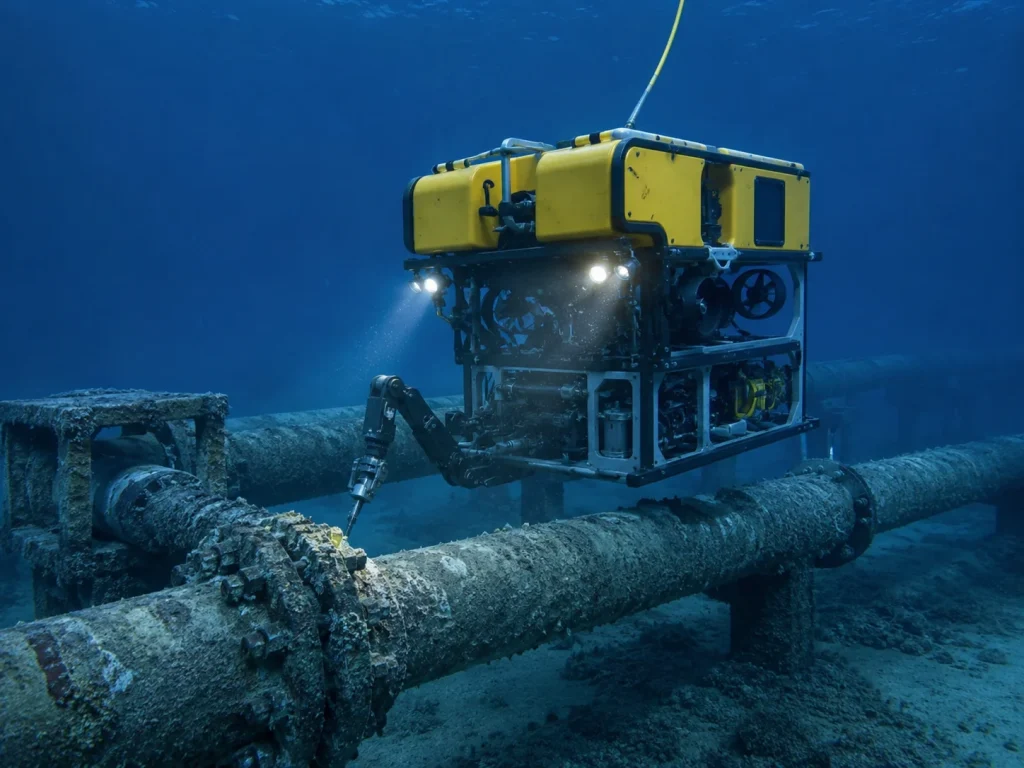
Density Reference for Marine Engineering Material Selection
Marine engineering materials require not only structural stability, but also higher buoyancy efficiency. High-density conventional materials increase equipment weight, launching difficulty, energy consumption and deep-sea operation costs.
| Material Type | Typical Density (g/cm³) |
|---|---|
| Steel | 7.8 |
| Ordinary Glass Fiber Composites | 1.8 – 2.0 |
| Epoxy Resin Matrix | 1.1 – 1.3 |
| Hollow Glass Microspheres | 0.15 – 0.60 |
Note: HGM can help realize higher net buoyancy, lighter structural weight, optimized buoyancy-to-weight ratio, and lower transportation and deployment costs.
Hollow Glass Microspheres Product Structure for Marine Engineering
Different marine environments require different density and compressive strength directions. Product selection should be determined based on actual marine service environment and processing conditions.
| Product Series | Typical Density (g/cc) | Typical Compressive Strength (psi) | Main Marine Engineering Applications |
|---|---|---|---|
| Ultra-Low Density Grade | 0.15 – 0.25 | 3,000 – 6,000 | Shallow sea buoyancy systems |
| Medium Strength Grade | 0.30 – 0.46 | 6,000 – 10,000 | Marine composites & structural parts |
| High Strength Grade | 0.46 – 0.60 | 10,000 – 18,000 | Deep-sea syntactic foam & deep-sea buoyancy materials |
Note: Actual technical parameters vary according to particle size distribution, wall thickness and production processes.
How to Choose the Right Marine HGM Grade?
Select the grade based on target depth, buoyancy efficiency, hydrostatic pressure requirement, seawater stability, processing system, and long-term service environment.
- Shallow Sea Buoyancy
- Marine Composites
- Deep-Sea Syntactic Foam
- Subsea Insulation
Key Selection Factors for Marine Engineering
Low Density
Helps improve net buoyancy and reduce equipment structure weight.
Buoyancy Efficiency
Supports optimized buoyancy-to-weight ratio for underwater equipment.
Pressure Resistance
High-strength grades support deep-sea hydrostatic pressure conditions.
Seawater Stability
Borosilicate glass supports chemical inertness and environmental stability.
Thermal Management
Thermal conductivity of 0.04–0.10 W/m·K supports subsea insulation needs.
Typical Marine Engineering Application Fields of HGM
Deep-Sea Syntactic Foam
Marine Composites
ROV & UUV Systems
Subsea Insulation Systems
Processing Compatibility for Marine Engineering
Different production processes have distinct requirements on microsphere particle size, compressive strength, dispersion uniformity, water absorption rate and surface modification treatment. Formula and grade optimization are necessary for mass production.
| Processing Technology | Typical Application |
|---|---|
| Epoxy Resin Systems | Deep-sea syntactic foam production |
| Composite Lamination | Marine composite structural parts |
| Casting Systems | Integral buoyancy modules |
| Vacuum Infusion Process | Lightweight marine composites |
| Syntactic Foam Forming | Professional deep-sea buoyancy materials |
Marine Engineering Sourcing Do’s
Recommended Sourcing Practices
✅ Define service depth and hydrostatic pressure requirements
✅ Match grade direction with buoyancy and structural needs
✅ Evaluate long-term seawater stability and water absorption
✅ Check process compatibility before mass production
✅ Validate performance under actual marine service conditions
Common Sourcing Mistakes
❌ Choosing only by low density without pressure evaluation
❌ Ignoring actual service depth and long-term seawater exposure
❌ Using non-marine grade selection logic for deep-sea systems
❌ Overlooking dispersion and casting process requirements
❌ Ignoring thermal insulation needs in subsea pipeline systems
Customization & Technical Support
Ocean Elite can support marine HGM selection based on buoyancy efficiency, hydrostatic pressure, seawater stability, processing conditions, thermal insulation needs and final system performance.
- Marine grade direction review
- Pressure and density matching
- Particle size and dispersion support
- Process compatibility guidance
- Application testing and validation
ROI & Sustainable Development Value
By realizing lightweight design of marine engineering equipment, HGM can cut down logistics expenses, lower energy consumption during launching and recovery, improve overall buoyancy utilization rate and promote comprehensive operational performance.
Global marine engineering is advancing toward deep-sea exploration, intelligent operation, lightweight structure and long-service-life design.
Frequently Asked Questions
1.Why are hollow glass microspheres suitable for marine engineering?
They feature low density, high buoyancy efficiency, outstanding compressive strength and reliable long-term environmental stability, suitable for diverse marine engineering application scenarios.
2.Are hollow glass microspheres applicable to deep-sea environments?
Yes. High-strength HGM grades are specially developed to adapt to high hydrostatic pressure in deep sea. The applicable service depth shall be confirmed according to overall structural design.
3.What is syntactic foam?
Syntactic foam is a high-performance composite material mainly composed of hollow glass microspheres and resin matrix, which is a core mainstream material for manufacturing deep-sea buoyancy components.
4.Can hollow glass microspheres reduce the weight of marine equipment?
Yes. With typical density ranging from 0.15 to 0.60 g/cc, far lower than traditional marine structural materials, HGM can significantly reduce the overall weight of finished equipment.
5.Are hollow glass microspheres applicable to marine composite materials?
Absolutely. Marine composites are one of the most mature and mainstream application fields of hollow glass microspheres.