
Key Solutions: Lightweighting Solutions
Redefining Lightweight Material Systems with Hollow Glass Microspheres
Ocean Elite provides lightweighting solutions using hollow glass microspheres to help modern material systems reduce weight while improving energy efficiency, dimensional stability, processing performance, and long-term product value.
Low Density
High Crush Strength
Thermal Insulation
Dimensional Stability
Processing Compatibility
Weight Reduction Focus
Designed to reduce system density while maintaining volume and product function.
10%–40% Potential
Typical lightweighting effect depends on loading level, resin system, grade, and process.
Material System Logic
HGM works through volume-for-volume replacement of higher-density resin or fillers.
Multi-Process Fit
Compatible with injection molding, extrusion, SMC/BMC, coatings, sealants, and syntactic foam.
Engineering Support
Grade selection should match density, particle size, strength, and process conditions.
Cost & ESG Value
Supports volumetric cost optimization, lower transport weight, and carbon reduction goals.
Ocean Elite Lightweighting Solutions
Modern manufacturing is moving toward lightweight material systems. In electric vehicles, industrial composites, aerospace, marine engineering, building insulation, and high-performance plastics, material weight directly affects energy efficiency, battery range, structural design, processing efficiency, installation cost, and long-term product performance.
Hollow Glass Microspheres provide a more integrated lightweighting solution through the combination of low density, high compressive strength, thermal insulation, and dimensional stability.
- Reduce system weight while maintaining volume and product dimensions.
- Improve energy efficiency, battery range, and installation efficiency.
- Support better flowability, shrinkage control, and dimensional stability.
- Provide insulation and acoustic optimization benefits in selected systems.
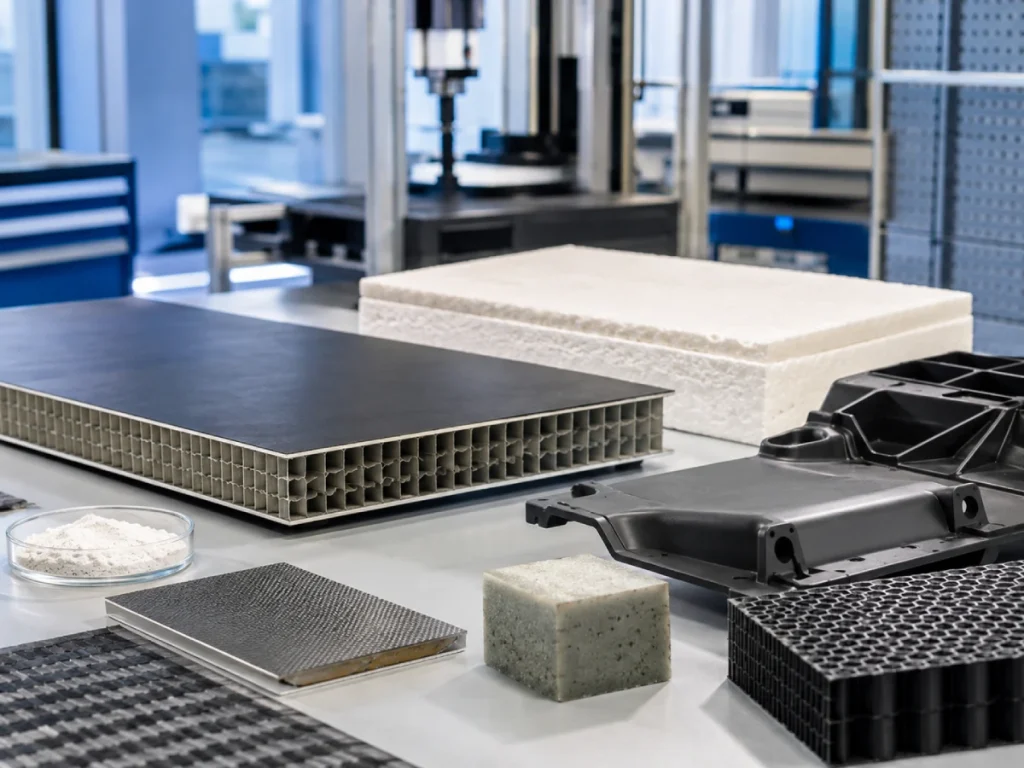
Why More Lightweight Systems Are Using Hollow Glass Microspheres?
| Traditional Solution | Common Issues |
|---|---|
| Foaming Systems | Poor dimensional stability and reduced mechanical strength |
| Conventional Lightweight Fillers | Insufficient strength and processing breakage |
| Reduced Wall Thickness | Structural rigidity reduction |
| High Glass Fiber Loading | Improved strength but increased density |
Compared with Conventional Lightweight Systems
Hollow glass microspheres offer ultra-low density, high crush strength, excellent flowability, thermal insulation, dimensional stability, and processing adaptability.
- Ultra-low density
- High crush strength
- Excellent flowability
- Thermal insulation
- Dimensional stability
- Processing adaptability
How Hollow Glass Microspheres Reduce Weight
Because hollow glass microspheres contain enclosed air or inert gas inside the structure, they achieve extremely low true density. Within composite systems, HGMs reduce weight through “Volume-for-Volume Replacement,” replacing portions of high-density resin or conventional fillers while maintaining part dimensions and volume.
| Material Type | Typical Density (g/cm³) |
|---|---|
| Calcium Carbonate | 2.7 |
| Talc | 2.7 – 2.8 |
| Glass Fiber | 2.5 |
| PP / PA / Epoxy Resin Systems | 0.9 – 1.3 |
| Hollow Glass Microspheres | 0.15 – 0.60 |
Depending on loading level, resin system, microsphere strength grade, processing conditions, and final mechanical requirements.
W/m·K, supporting insulation, reduced heat transfer, and selected acoustic optimization needs.
Hollow Glass Microspheres Product Structure
Hollow glass microspheres can be selected according to density target, crush strength requirement, and final application environment. Ultra-low density grades are suitable for maximum weight reduction, medium strength grades balance lightweight performance with processing stability, while high strength grades are better for demanding composite, SMC/BMC, and deep-sea buoyancy applications.
| Product Direction | Typical Density (g/cc) | Typical Crush Strength (psi) | Typical Applications |
|---|---|---|---|
| Ultra-Low Density Grade | 0.15 – 0.25 | 3,000 – 6,000 | Putty, coatings, building insulation |
| Medium Strength Grade | 0.30 – 0.46 | 6,000 – 10,000 | PP/PA compounds, automotive plastics |
| High Strength Grade | 0.46 – 0.60 | 10,000 – 18,000 | Engineering composites, deep-sea buoyancy, SMC/BMC |
Note: Actual performance may vary depending on manufacturing systems, particle size distribution, and wall thickness design. Material selection should be optimized according to processing conditions.
Lightweighting Grades & Selection Guide
This selection guide helps match lightweighting goals with the right hollow glass microsphere grade direction. If your project only needs maximum weight reduction, ultra-low density grades are usually preferred. If your material must handle injection molding, extrusion, SMC/BMC, or structural load requirements, medium to high strength grades should be considered for better crush resistance and long-term stability.
| Lightweighting Goal | System Requirements | Suggested Grade Direction | Key Benefits |
|---|---|---|---|
| Maximum weight reduction | Lowest density possible; non-structural parts | Ultra-Low Density Series (0.15–0.25 g/cc) | Ultra-low density and cost-effective weight reduction |
| Balanced density and handling | Good balance of density, flowability, and strength | Medium Strength Series (0.30–0.46 g/cc) | Balanced density, strength, and processing performance |
| Higher processing stability | Thermoforming, injection molding, extrusion systems | Medium to High Strength Series (0.30–0.60 g/cc) | Better crush resistance and processing stability |
| High-strength lightweight structures | Structural parts and high-load composite applications | High Strength Series (0.46–0.60 g/cc) | High strength, dimensional stability, and reliability |
Note: Final grade selection should consider target weight reduction, required crush strength, particle size preference, process temperature, resin compatibility, and final product performance targets.
How to Choose the Right Lightweighting Direction?
Match your performance targets with the correct microsphere grade to achieve weight reduction without sacrificing processing stability or final reliability.
Maximum Weight Reduction
Balanced Density & Handling
Higher Processing Stability
High-Strength Lightweight Structures
Key Selection Factors for Hollow Glass Microspheres
True Density
Lower true density brings greater weight reduction potential and system efficiency improvement.
Crush Strength
High crush strength helps maintain structural reliability under pressure and processing conditions.
Particle Size Distribution
Optimized PSD improves flowability, dispersion behavior, and final surface quality.
Recommended Addition Ratio
Proper dosage ensures weight reduction while protecting mechanical performance.
Matrix Compatibility
Good compatibility with resin systems helps long-term stability and durability.
Hollow Glass Microspheres Applications by Industry
Electric Vehicles
Industrial Composites
Aerospace
Marine Engineering
Building Insulation
High-Performance Plastics
Ocean Elite Lightweighting Sourcing Do’s and Don’ts
Recommended Sourcing Practices
✅ Define weight reduction goals and performance targets.
✅ Select the right grade based on system requirements.
✅ Validate through pilot testing and parameter matching.
✅ Evaluate supply consistency and documentation.
Common Sourcing Mistakes
❌ Choosing grades based only on lowest price.
❌ Ignoring crush strength and processing suitability.
❌ Using unstable testing standards.
❌ Overlooking long-term reliability and durability.
Customization & Technical Support
Ocean Elite offers custom grade selection, technical consultation, and application support to help buyers match hollow glass microspheres with lightweighting goals.
- Custom grade development
- Application parameter optimization
- Material testing and performance validation
- On-site technical support
- Long-term supply and quality consistency
Quality-Controlled Hollow Glass Microspheres with Testing Documentation
Ocean Elite ensures stable and consistent performance through strict quality control and complete testing documentation.
- Incoming raw material inspection
- Density and crush strength verification
- Particle size and breakage rate testing
- Batch traceability and quality records
- Application-specific support and guidance

Frequently Asked Questions
1. How much weight reduction can hollow glass microspheres achieve?
Hollow glass microspheres can typically help achieve about 10%–40% weight reduction, depending on the loading level, resin system, microsphere strength grade, processing conditions, and final mechanical performance requirements.
2. Are hollow glass microspheres suitable for injection molding?
Yes. Medium and high-strength HGM grades can be used in injection molding systems such as PP, PA6, and PA66 engineering plastics. For high-pressure processing, grade selection should consider crush strength, particle size, and processing temperature.
3. Will hollow glass microspheres make the final product weaker?
Not necessarily. When the correct grade is selected, HGM can reduce density while helping maintain dimensional stability, processing flowability, and structural balance. For high-load parts, high-strength grades are recommended instead of ultra-low density grades.
4. Which industries commonly use HGM lightweighting solutions?
HGM lightweighting solutions are commonly used in electric vehicles, industrial composites, aerospace, marine engineering, building insulation, high-performance plastics, coatings, adhesives, sealants, SMC/BMC systems, and syntactic foam.
5. Can hollow glass microspheres improve thermal insulation?
Yes. Because hollow glass microspheres contain internal air or inert gas, they usually provide low thermal conductivity. Typical thermal conductivity ranges from about 0.04–0.10 W/m·K, supporting insulation, reduced heat transfer, and selected acoustic optimization needs.
6. How should I choose the right HGM grade for a lightweighting project?
Start with your target weight reduction, required crush strength, processing method, resin compatibility, particle size preference, and final product performance target. Ultra-low density grades are better for maximum weight reduction, while medium and high-strength grades are better for injection molding, SMC/BMC, structural composites, and high-pressure systems.