
High Strength Hollow Glass Microspheres
Higher Compressive Strength. Lower Breakage Rate. Stronger Structural Reliability.
Ocean Elite High Strength Hollow Glass Microspheres are engineered for high-load composite materials, engineering plastics, SMC/BMC systems, injection molding, and deepwater composite applications where compressive strength and processing stability matter.
Low Density
Low Density
Low Density
Low Density
Low Density
Multiple Grades Available
A full range of high strength HGM grades for different pressure and processing needs.
High Compressive Strength
8000–18000 psi compressive strength for high-pressure processing.
Engineered for Stability
Stable hollow structure for mechanical pressure and hydrostatic environments.
Application-Focused
Designed for plastics, SMC/BMC, injection molding, and deepwater composites.
Strict Quality Control
Consistent density, particle size, and strength for reliable application performance.
High-Performance Hollow Glass Microspheres from Ocean Elite
High strength hollow glass microspheres provide a practical way to reduce system density while improving survival rate under demanding processing conditions.
Compared with ultra-low density grades, high strength HGM is selected when the application requires better compressive strength, lower breakage risk, and stable hollow structure under injection molding, extrusion, compounding, SMC/BMC processing, or long-term pressure exposure.
- High compressive strength range: 8000–18000 psi
- True density range: 0.46–0.60 g/cm³
- Recommended loading ratio: 5–25 wt%
- Suitable for high-pressure processing and structural composite systems
- Useful when weight reduction must be balanced with long-term reliability
Parameter | Typical Range | Engineering Significance |
Compressive Strength | 8000–18000 psi | Reduce Processing Breakage Rate |
True Density | 0.46–0.60 g/cm³ | Balance Weight Reduction and Structural Strength |
Particle Size Range | 20–100 μm | Affect Dispersion and Surface Performance |
Recommended Loading Ratio | 5–25 wt% | Improve System Durability |
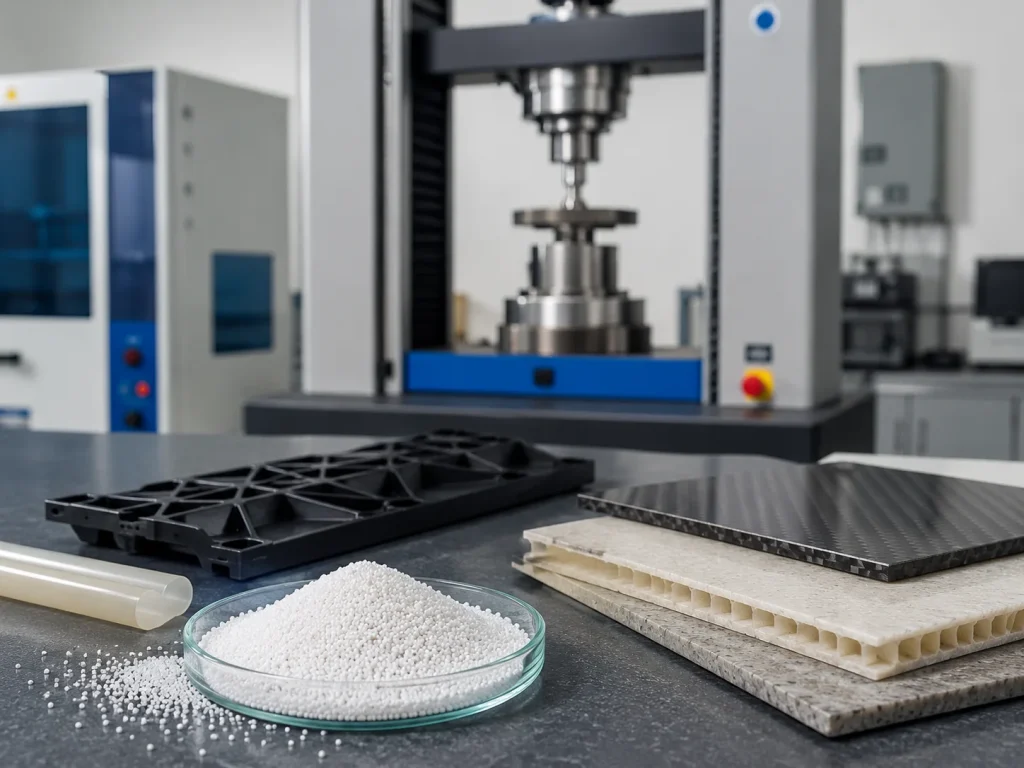
High Strength HGM Series TDS Parameters
The High Strength HGM Series provides multiple density and compressive strength options for lightweight and high-performance material systems. With controlled particle size distribution, low thermal conductivity, and stable true density, these hollow glass microspheres are suitable for composites, coatings, sealants, and pressure-resistant industrial formulations.
| Series | Isostatic Compressive Strength / Test Pressure (MPa / Psi) | Tap Density (g/cm³) | True Density (±0.015 g/cm³) | Thermal Conductivity (W/(m·K)) | Particle Size (μm) | ||
|---|---|---|---|---|---|---|---|
| D10 | D50 | D90 | |||||
| HGM46 | 55.2 / 8000 | 0.28 | 0.46 | 0.078 | 18 | 35 | 62 |
| HGM50 | 68.9 / 10000 | 0.30 | 0.50 | 0.082 | 14 | 32 | 52 |
| HGM60 | 110 / 16000 | 0.36 | 0.60 | 0.093 | 13 | 28 | 51 |
| HGM46HS | 110 / 16000 | 0.28 | 0.46 | 0.078 | 16 | 35 | 62 |
| HGM60HS | 124 / 18000 | 0.36 | 0.60 | 0.093 | 13 | 28 | 51 |
High Strength HGM Grades & Selection Guide
| Selection Direction | Main Factor | Suitable Application | Suggested Grade Direction |
|---|---|---|---|
| Maximum weight reduction | Lowest true density and high volume efficiency | Lightweight coatings, low-density fillers, non-high-pressure systems | Start with HGM46 or HGM50 |
| Balanced density and handling | Low density with improved processing stability | Adhesives, coatings, resin systems | Start with HGM50 or HGM60 |
| Higher processing stability | Higher compressive strength and better stability under processing | Engineering plastics, SMC/BMC composites, injection molding | Evaluate HGM60, HGM46HS, or HGM60HS |
| High-pressure or long-term pressure applications | Best pressure resistance and lower breakage rate | Deepwater composites, high-load composites, structural applications | Evaluate HS grades based on pressure and service conditions |
Note: High Strength HGM grades should be selected based on your target density reduction, required processing stability, application pressure conditions, and end-use system design. For engineering plastics, SMC/BMC composites, injection molding, and deepwater composite applications, Ocean Elite recommends small-scale formulation validation before final grade selection to balance weight reduction, flow behavior, and mechanical performance.
How to Choose the Right High Strength HGM Grade?
Select the grade based on density target, compressive strength requirement, pressure resistance expectation, particle size preference, and processing conditions.
Maximum Weight Reduction
Balanced Density & Handling
Higher Processing Stability
High-Pressure Application
Key Selection Factors for High Strength Hollow Glass Microspheres
Compressive Strength
Choose higher compressive strength when processing pressure or long-term load is demanding.
True Density
Balance density reduction with structural strength and particle survival.
Particle Size
Particle size influences dispersion, surface finish, and system viscosity.
Processing Pressure
Injection molding, extrusion, and compounding may require HS grade evaluation.
Application Environment
Deepwater, hydrostatic, and load-bearing applications need stronger hollow structure stability.
Typical Application Areas
Engineering Plastics
Injection Molding Systems
SMC / BMC Composite Materials
Deepwater Composite Materials
Processing Recommendations
Although high strength HGM offers better structural integrity, optimized processing helps further minimize breakage risk.
| Processing Focus | Recommendation |
|---|---|
| Grade Selection | Select the appropriate grade based on processing pressure |
| Shear Control | Control high-speed mixing and shear rate |
| Dispersion Stability | Ensure uniform dispersion |
| Pilot Testing | Test breakage rate before scale-up production |
Ocean Elite Sourcing Do's and Don'ts
Recommended Sourcing Practices
✅ Define application pressure conditions clearly
✅ Match grade with processing environment
✅ Request technical data and samples
✅ Validate breakage rate and density stability
Common Sourcing Mistakes
❌ Using low-strength grades in high-pressure applications
❌ Ignoring breakage rate during processing
❌ Overlooking particle size matching
❌ Choosing only by lowest density.
Customization & Technical Support
Ocean Elite can support customized solutions for high-strength HGM based on your application needs.
- Particle size distribution adjustment
- Surface treatment options
- Custom strength grade matching
- Application testing and validation
- Technical documentation support
Quality-Controlled HGM System & Documentation
Reliable high-strength HGM requires consistent quality control from incoming materials to batch delivery.
- Material inspection
- In-process quality monitoring
- Density and strength verification
- Batch traceability support

Frequently Asked Questions
1. What is High Strength Hollow Glass Microspheres used for?
High Strength Hollow Glass Microspheres are used in engineering plastics, injection molding systems, SMC/BMC composite materials, and deepwater composite materials where lightweight performance, compressive strength, and structural stability are required.
2. How is it different from ultra-low density HGM?
Ultra-low density HGM focuses mainly on maximum weight reduction. High strength HGM uses higher compressive strength and a more stable hollow structure to reduce breakage during high-pressure processing or long-term pressure exposure.
3. What loading ratio is recommended?
The recommended loading ratio is typically 5–25 wt%, depending on the resin system, processing method, pressure condition, and required balance between weight reduction and mechanical performance.
4. Which grades are available for high strength applications?
Available high strength grades include HGM46, HGM50, HGM60, HGM46HS, and HGM60HS, with isostatic compressive strength ranging from 8000 psi to 18000 psi.
5. Can High Strength HGM be used in injection molding?
Yes. High Strength HGM can be used in injection molding systems where the goal is to reduce system density while maintaining better particle survival under high-pressure processing conditions.
6. Can it be used in deepwater composite materials?
Yes. High Strength HGM is suitable for deepwater composite materials where long-term hydrostatic stability and pressure resistance are important engineering requirements.
7. How should breakage rate be tested?
Breakage rate should be tested after actual mixing, compounding, injection molding, extrusion, or pilot production conditions, rather than only before processing.
8. Can Ocean Elite support custom grade selection?
Yes. Ocean Elite can support grade selection based on target density, compressive strength requirement, processing pressure, particle size preference, and end-use application conditions.