
Low Density Materials
Lightweight filler solutions engineered for density reduction, thermal insulation support, and stable processing performance.
Ocean Elite Low Density HGM helps reduce formulation weight while supporting practical flowability in coatings, adhesives, plastics, and low-density cementing systems.
Low Density
Low Thermal Conductivity
Good Flowability
Lightweight Filler
Processing Stability
Processing Stability
Processing Stability
Application-Based Selection
Application-Based Selection
Application-Based Selection
Density, particle size, conductivity.
Custom Selection Support
Grade direction by formulation target.
Processing Risk Awareness
Low shear and small-scale validation.
Low shear and small-scale validation.
Low density hollow glass microspheres are lightweight, hollow, inorganic filler materials designed to reduce formulation density while supporting flowability and thermal insulation performance. Compared with traditional solid mineral fillers, their hollow spherical structure can significantly reduce composite density while maintaining basic structural stability.
For projects where weight reduction is the primary objective, Ocean Elite Low Density HGM provides a practical selection route across true density, compressive strength, particle size, and thermal conductivity.
- Helps reduce overall formulation weight
- Provides additional thermal insulation contribution
- Improves flowability through spherical particle structure
- Supports lightweight composite and coating design
- Helps reduce slurry density in low-density cementing systems
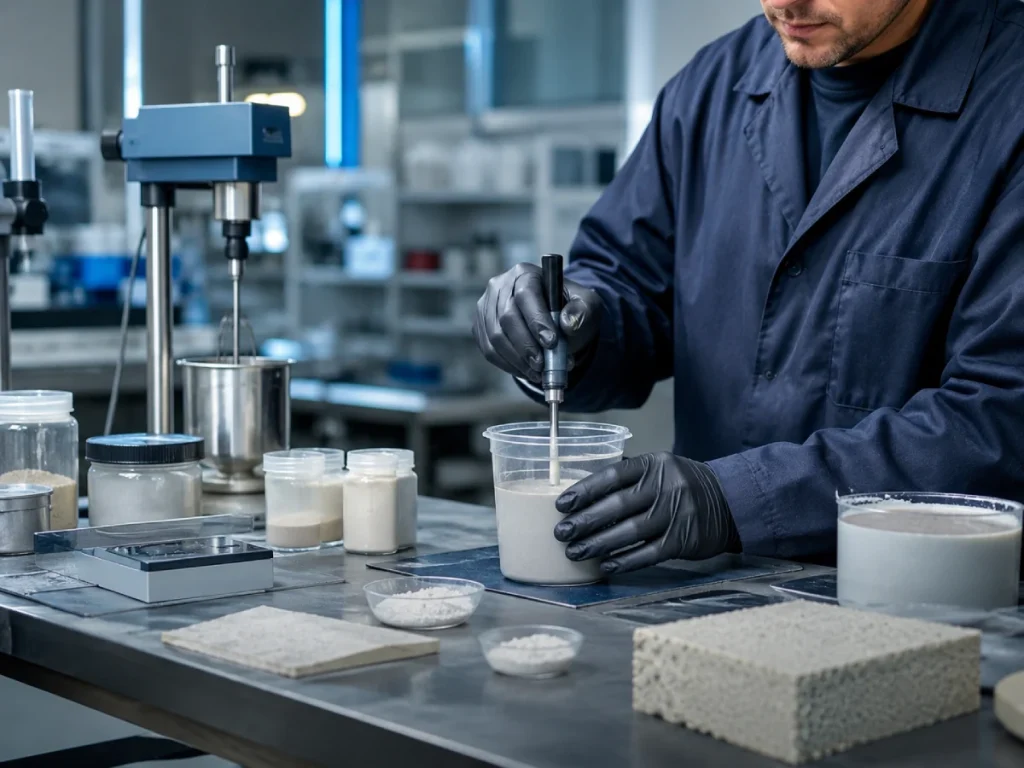
Core Performance of Low Density Hollow Glass Microspheres
Lightweight Performance
By replacing traditional mineral fillers with hollow structures, the overall density of composite systems can typically be reduced by 10–35%, depending on formulation design and loading ratio.
Low Thermal Conductivity & Thermal Insulation Performance
Because the particles contain an internal air-filled cavity, low density HGM can help reduce heat transfer efficiency and provide additional insulation contribution in coatings, building materials, and industrial insulation systems.
Improved Flowability & Processing Performance
The spherical structure creates a ball-bearing effect within resin and coating systems, helping improve flowability, dispersion uniformity, and application stability.
| Parameter | Typical Range | Engineering Significance |
|---|---|---|
| True Density | 0.15–0.38 g/cm³ | Higher weight reduction efficiency |
| Thermal Conductivity | 0.04–0.06 W/m·K | Provides additional thermal insulation |
| Particle Size Range | 20–100 μm | Affects dispersion and surface performance |
| Recommended Loading Ratio | 3–20 wt% | Balances weight reduction and processability |
Low Density Hollow Glass Microspheres Series TDS Parameters
The following low density HGM series data should be used as the starting point for grade comparison.
| Series | Isostatic Compressive Strength/Test Pressure (MPa/Psi) | Tap Density (g/cm³) | True Density (±0.015 g/cm³) | Thermal Conductivity (W/(m·K)) | D10 (μm) | D50 (μm) | D90 (μm) |
|---|---|---|---|---|---|---|---|
| HGM15 | 3.4/500 | 0.10 | 0.15 | 0.04 | 28 | 57 | 102 |
| HGM20 | 5.2/750 | 0.12 | 0.20 | 0.048 | 23 | 43 | 73 |
| HGM25 | 6.9/1000 | 0.15 | 0.25 | 0.05 | 23 | 43 | 73 |
| HGM30 | 13.8/2000 | 0.18 | 0.30 | 0.056 | 21 | 41 | 72 |
| HGM38 | 37.9/5500 | 0.22 | 0.38 | 0.065 | 18 | 37 | 66 |
| HGM25HS | 13.8/2000 | 0.15 | 0.25 | 0.051 | 23 | 43 | 73 |
| HGM30HS | 27.6/4000 | 0.18 | 0.30 | 0.056 | 19 | 38 | 65 |
Selection Note: Lower-density grades such as HGM15 and HGM20 are more suitable for maximum density reduction. Higher-strength or HS grades should be considered when the formulation faces higher processing stress, pressure conditions, or stricter mechanical stability requirements.
Low Density HGM Grades & Selection Guide
| Selection Direction | Main Factor | Suitable Application | Suggested Grade Direction |
|---|---|---|---|
| Maximum weight reduction | Lowest true density and high volume efficiency | Lightweight coatings, low-density fillers, non-high-pressure systems | Start with HGM15 or HGM20 |
| Balanced density and handling | Low density with improved processing stability | Adhesives, coatings, resin systems | Start with HGM20 or HGM25 |
| Higher processing stability | Higher compressive strength and better stability under processing | Plastics, SMC, engineering composites | Evaluate HGM30, HGM38, HGM25HS, or HGM30HS |
| Low-density cementing | Density reduction with pressure and rheology consideration | Low-density cementing and oilfield systems | Evaluate HS grades based on field pressure and slurry conditions |
Note:Low-density HGM grades should be selected based on your target density reduction, required processing stability, application pressure conditions, and end-use system design. For lightweight coatings, adhesives, plastics, and low-density cementing systems, Ocean Elite recommends starting with small-scale formulation validation before final grade selection to balance weight reduction, flow behavior, and mechanical performance.
How to Choose the Right Low Density HGM Grade?
Select the grade based on density target, compressive strength requirement, thermal insulation expectation, particle size preference, and processing conditions.
Maximum Weight Reduction
Balanced Density & Handling
Higher Processing Stability
Low-Density Cementing
Key Selection Factors for Low Density Materials
True Density
Controls the final lightweighting effect of the material system.
Compressive Strength
Affects whether microspheres can withstand mixing, compounding, pumping, or molding.
Thermal Conductivity
Supports insulation contribution in coatings and thermal protection systems.
Particle Size Distribution
Influences dispersion, surface finish, viscosity, and processing stability.
Recommended Loading Ratio
Commonly adjusted from 3–20 wt% according to target density and viscosity.
Processing Method
Low-shear mixing helps reduce particle breakage risk.
Solid Buoyancy Materials Applications by Industry
Industrial Coatings & Thermal Insulation Coatings
Adhesives
Automotive Lightweight Plastics
Low Density Cementing Systems
Low Density HGM Sourcing Do’s
Recommended Sourcing Practices
✅ Define target density, viscosity, and processing method first.
✅ Compare true density, tap density, compressive strength, thermal conductivity, and particle size together.
✅ Test small batches before scaling up.
✅ Match grade to real process conditions.
Common Sourcing Mistakes
❌ Choosing only by low density while ignoring compressive strength.
❌ Using high-speed dispersion without considering particle breakage.
❌ Applying one grade across all systems without validation.
❌ Ignoring viscosity change and final mechanical performance.
Customization & Technical Support
Low density HGM selection should be connected to your real formulation target. A coating system may prioritize thermal insulation and application performance, while an adhesive system may pay more attention to flowability, shrinkage control, and density reduction.
Ocean Elite can support grade comparison based on application direction, true density, compressive strength, particle size distribution, thermal conductivity, and processing method.
Processing Recommendations
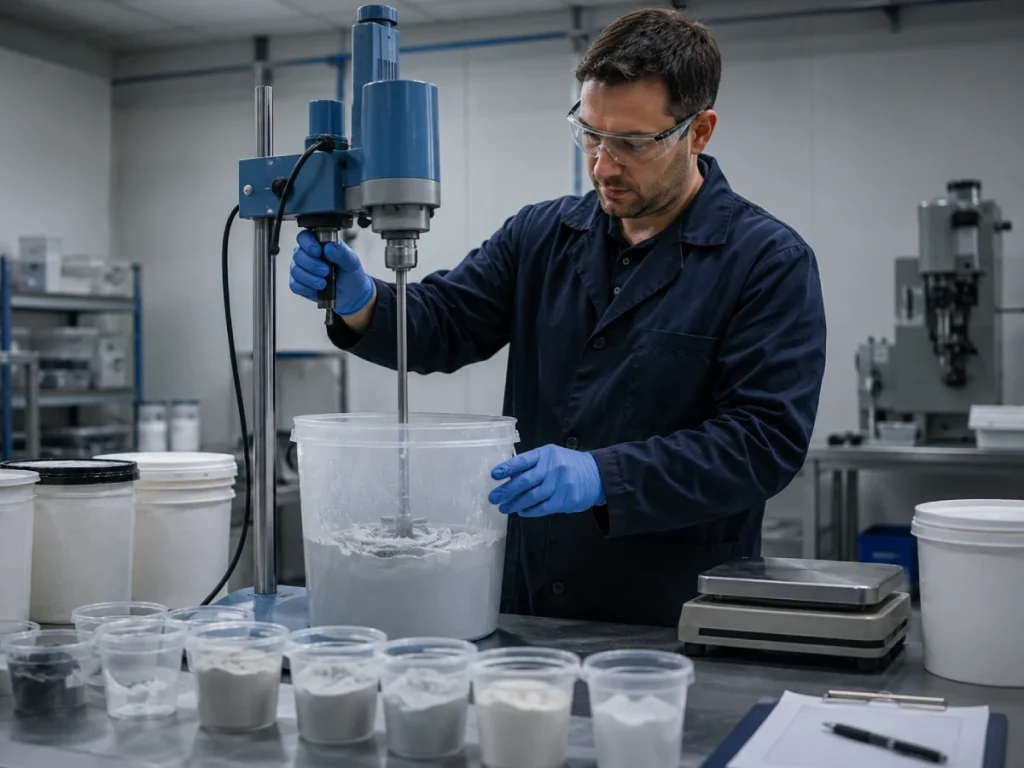
Because low density hollow glass microspheres are selected mainly for weight reduction efficiency, particle breakage risk should be minimized during processing.
| Processing Focus | Recommendation |
|---|---|
| Mixing Method | Use low-shear mixing |
| Dispersion Process | Avoid high-speed dispersion |
| Loading Ratio | Conduct small-scale validation first |
| System Balance | Balance weight reduction and mechanical properties |
Frequently Asked Questions
1.What are Low Density Hollow Glass Microspheres used for?
Low Density Hollow Glass Microspheres are used in lightweight composites, industrial coatings, adhesives, engineering plastics, and low-density cementing systems where weight reduction, low thermal conductivity, and improved flowability are required.
2.Which HGM grades are listed for low density applications?
The low density HGM grades listed for this page include HGM15, HGM20, HGM25, HGM30, HGM38, HGM25HS, and HGM30HS.
3.What true density range is available for these low density HGM grades?
The listed true density range is 0.15–0.38 g/cm³, depending on the selected HGM grade.
4.What thermal conductivity range is shown for Low Density HGM?
The typical thermal conductivity range shown for Low Density HGM is 0.04–0.065 W/(m·K), depending on grade selection.
5.How much Low Density HGM should be added?
The recommended loading ratio is typically 3–20 wt%, but small-scale validation should be completed first to balance weight reduction, processability, viscosity, and final mechanical performance.
6.What should be avoided during processing?
High-speed dispersion and excessive shear should be avoided because low density hollow glass microspheres require careful processing to reduce particle breakage risk.
7.Which grade should be selected for maximum weight reduction?
For maximum weight reduction, lower-density grades such as HGM15 or HGM20 are usually the first evaluation direction, provided the required pressure resistance and processing conditions are suitable.
8.Can Low Density HGM be used in low-density cementing systems?
Yes. Low Density HGM can reduce slurry density, improve adaptability to low-pressure formations, and help optimize thermal conductivity and rheological performance in cementing systems.